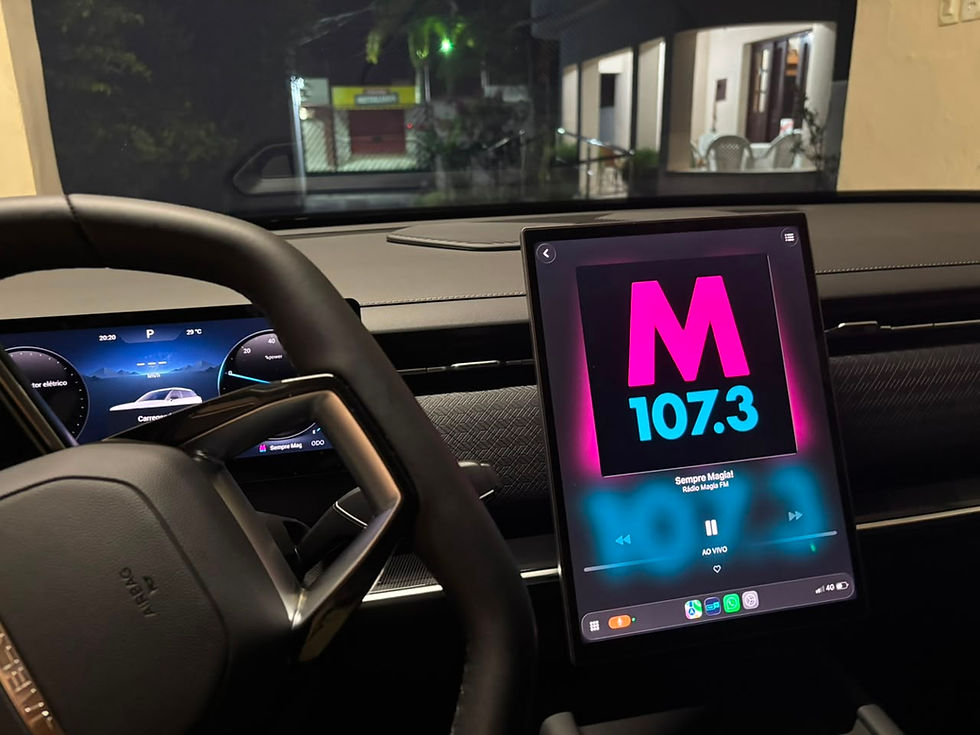
Tests of a new digital radio standard this week, and it was not DAB+, HD Radio, or DRM, a standard that is born this year

Tests of a new digital radio standard and, as the title already anticipates, none of the three major standards took part in these trials. The work was experimental and laboratory-based in nature, but it also included extensive field operation across different geographic conditions. The tests, in addition to their more scientific and preparatory phase/aimed at the production of papers containing parameters, descriptions, detailed analyses, and a broad set of information and comparisons were highly practical.

This material will serve both the general public and as an official document for analysis, enabling supervised testing by competent authorities, now at scale and in real field conditions, under broader international scrutiny. Thus, much of this curiosity is expected to be gradually revealed.
Direct and robust comparisons between analog radio coverage and digital transmission, as well as a wide diversity of reception locations, were exhaustively explored. Repetition tests made it possible to obtain solid records proving performance invariability in the face of atmospheric changes or nearby electrical events.
Some observations from the tests can already be anticipated:
No conflict between analog and digital signals was observed.
Delay between analog and digital signals: yes, as expected in digital transmissions.
Shadowing comparison between analog and digital signals: the digital signal showed virtually no shadowing within the protected contour. The silenced signal represented only 0.027% of route A, and there was no signal drop on route B. The analog signal, on the other hand, presented several points of noise and fading (map detailing).
Digital audio quality: configurable. The test used a bitrate of 96 kbps in AAC+.
Maximum distance between the receiving vehicle and the station (line-of-sight): route A at 28.5 km and route B at 25.4 km.
For the time being, the country where the tests were conducted will remain undisclosed and will be revealed at an appropriate moment.
In terms of deployment costs, and precisely because it has very low costs for both broadcasters and listeners, this explains its emergence, even at a late stage, making it possible to enter the field despite players that have already been in the game for decades.Another crucial point, and perhaps one with even greater impact on confidence in adopting this new system, is precisely that its deployment is simpler and faster. These combined factors explain why it is possible to enter the field even with giants such as DAB+, HD Radio, and DRM having been in play for many years.
The other point of differentiation is that this digital transmission standard, although adjustable in terms of kbps rate and sampling, proves that it is unnecessary to reduce quality in order to gain reception stability in receivers. On the contrary, we will strongly discourage transmissions below 64 kbps in AAC+, so that it is clearly understood that digital broadcasting is premised on full tuning reliability and audio quality superior to any analog FM/AM transmission.
About me - Ricardo C. F. Gurgel
There are things in life you simply cannot escape. I have always had a hyperfocus on radio and on everything connected to this world of communications, and yes, I lost a lot of time and money just thinking about radio-related matters. I spent weekends doing calculations, making assumptions, and having many other thoughts that would be unimaginable to most people’s minds. After all, it was generally a great deal of energy devoted to things with no financial meaning whatsoever nothing more than a hobby thinking about radio and the new forms radio could take.
I am nothing extraordinary. I live an ordinary life, but one aspect of being hyperfocused is that you can truly fixate on things seen as banal, with no external pressure to find solutions. It might be something as random as cockroach shells and end up discovering a UV-protective wax. It is precisely these “absurdities” that hyperfocus can lead to the most improbable discoveries.
Since the first years after the 2000s, I have been thinking about radio digitalization, and from the very beginning of the first digital system tests in Brazil, I had a clear vision that those models would not move forward in any meaningful way. Well, more than 15 years later, that vision has been confirmed and even further reinforced by the decline in interest. There has not even been a small advance. Today, what we see is an interest level far lower than what existed back then.
And the funny thing is that the solution began to take shape in my mind without me even realizing it, as I was creating an architecture that would actually resolve the very issues that stalled and generated the lack of interest in radio digitalization in Brazil.
And when the last piece came to me in the form of a random daydream, within a few minutes I was able to envision the entire process of a real transition from analog radio to digital, and that solution model left me just steps away from assembling and simulating how it would work.
Of course, I took steps to secure both national and international registrations, and there are deadlines that must be respected before any broad and fully detailed disclosure. This is a natural process that I could not ignore.
I did not even need a large infrastructure for the tests, which is even more encouraging. It is a structure compatible with reasonable timeframes and investment levels key factors for solving the slow adoption of digital standards that have been struggling for decades in brutal battles to achieve minimal and expensive advances.
And what about the industry that has already committed to other standards? Honestly, that is not a problem for them. Think of it like making a lot of money selling iPhones in 2010 and making even more through scale with a massively desired launch in 2026. In fact, one or more standards could even become partners. I do not see anything sustainable in a model based on volunteerism. Everything becomes much cheaper when there is a fair price. It is paradoxical, but calls for “collaboration” sound strange, because industries will make rivers of money when volunteers end up promoting their standards anyway.