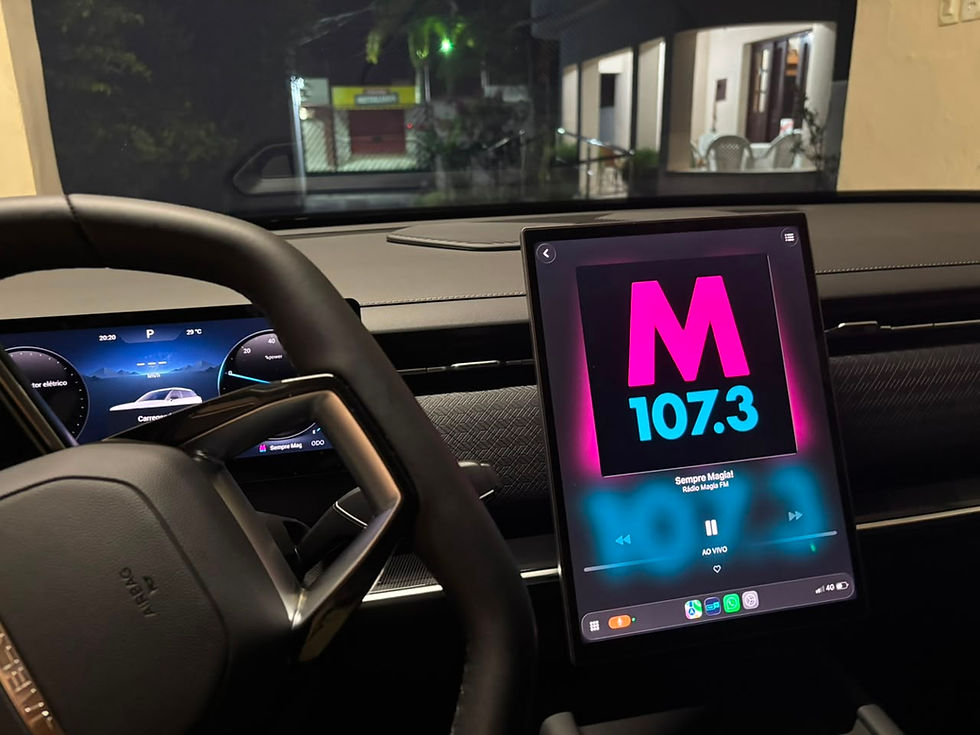
AlexCAR the digital and Infinite Dial: 20 radio stations with good reception within 40 km or 20,000 radio stations with unlimited range and flawless audio

There are two ecosystems for radio. The first uses an FM transmitter as its primary source, with analog audio subject to sound degradation as the listener moves farther away from the signal source. The second uses audio coming directly from the digital output of the station’s audio processor, which is not sent to a specific transmitter, but instead to an IP redundancy and distribution environment. This transmission can range from 48 kbps AAC+ to more than 256 kbps AAC+, already delivering, even at lower bitrates, audio quality superior to FM reception later converted into AAC+ at 64 kbps (48 kHz).
You will have all existing FM stations available within this ecosystem with digital audio access. This is not a system that reduces a station’s reach; on the contrary, it expands its coverage to a global scale and eliminates sound degradation, keeping the audio preserved in consistently high quality.
Imagine getting into your car and saying: “Car, play Jovem Pan Natal.”
The vehicle would execute a relatively simple process: verify whether the station broadcasts at least in 48 kbps AAC+. If so, that would become the primary audio source. If, for any reason, the digital signal is unavailable, the system would automatically switch to the FM signal.
One way or another, both are still forms of listening to radio. Whether the manufacturers of the old “typewriters” like it or not, geographically unlimited digital radio audio is arriving. Does this threaten radio? No. What this movement does is expand the reach of good radio stations, and that will not be for just any station.
There is no point in certain groups becoming upset about the definitive arrival of IP radio. This does not depend on me, nor is there any way to stop the process. There will not be enough force to prevent it. The scenario will be exactly this: getting into a car in the countryside of Northeastern Brazil, between Caicó and Natal, and asking to listen to New York’s Z100. Or driving through northern France and asking the car to play Jovem Pan Natal, a radio station from Northeastern Brazil.
And what is the timeline for this technology to become available? It could arrive tomorrow because it is that simple. In practice, it already exists today. It is the same principle as having an Alexa in your bedroom and asking it to play a radio station. Alexa does not search for frequencies between 76 MHz and 108 MHz; it accesses platforms such as TuneIn or RadiosNet. The next step is simply turning this into an “AlexaCar.”
Alerts
I do not agree with the idea that the FM signal should always be the preferred source, using IP only in the event of terrestrial signal failure.
In practice, the IP signal is already more present and, in many cases, more reliable than FM, even in large cities. There are countless reports of regions where several FM stations suffer from interference, in addition to the well known multipath effect, that strange distortion and hiss on FM even just a few kilometers from the transmitter.
In Natal, for example, several radio stations experience noticeable audio quality loss in the Tirol neighborhood due to reflections and interference. Outside the capitals and major regional cities, the situation becomes even more favorable to IP: 4G and 5G coverage tends to be much more dominant and consistent than local FM coverage. In many of these cities, it is simply easier to maintain continuous access to an IP signal than to the station’s terrestrial FM signal.
I also do not agree with immediate and automatic switching between analog and digital signals every time there is a fluctuation in signal strength.
Nothing is more annoying than a system alternating second by second between analog and digital audio: muffled sound, open sound, muffled sound again, open sound again.
The difference in sound quality between the two environments is far too large for this constant “ping pong” effect to go unnoticed by listeners.
Another point I disagree with is the obsession with millisecond synchronization between digital and analog audio. This is precisely what makes the entire system more expensive and unnecessarily complex.
In practice, it makes little or no difference whether you hear a Bruno Mars song at 9:23:12 or at 9:23:45. Digital audio naturally has delay, but that is trivial for the average listener. Extreme synchronization would only make sense to sustain this chaotic and instantaneous switching between FM and IP.
A more rational model would establish a simple transition rule: the IP signal should be the preferred source, and switching to FM should only occur if the stream remains without audio for more than 30 consecutive seconds.
Furthermore, today it is far more common to experience FM degradation or loss than a total loss of IP connectivity.
My proposal is simple: streaming should be the primary audio source, while FM should act only as an automatic redundancy system in case of prolonged absence of the digital signal.
• There are now two radio ecosystems: traditional FM and IP digital radio.
• FM depends on analog transmission and suffers audio degradation as distance increases.
• IP radio uses direct digital audio from the station’s processor, preserving high audio quality globally.
• Even a 48 kbps AAC+ stream can deliver cleaner sound than FM converted into AAC+ later.
• IP radio does not reduce coverage. It expands it worldwide.
• Imagine entering your car and saying: “Play Jovem Pan Natal.”
• The car would first check for the station’s digital AAC+ stream.
• If the IP stream is unavailable, the system could automatically switch to FM.
• Radio remains radio, regardless of whether it arrives through MHz or IP networks.
• Unlimited geographic radio distribution is no longer theory. It already exists.
• The same principle already works today with Alexa, TuneIn, and RadiosNet.
• The next step is simply turning this into an “AlexaCar.”
• Future listeners will request stations by name, not by frequency.
• A driver in Northeastern Brazil could listen to New York’s Z100.
• A driver in France could listen to Jovem Pan Natal from Brazil.
• IP radio strengthens strong radio brands instead of limiting them geographically.
• In many regions, 4G and 5G coverage is already more reliable than FM coverage.
• FM still suffers from interference, multipath distortion, hiss, and signal reflections.
• Constant switching between FM and digital audio creates an annoying listening experience.
• The sound quality gap between FM and digital streaming is too large to hide.
• Millisecond synchronization between FM and IP unnecessarily increases system complexity and cost.
• Most listeners do not care if a song arrives with a few seconds of delay.
• Streaming should become the primary source.
• FM should act only as an automatic backup system during prolonged IP outages.
• In practice, FM failures are often more common than total IP loss.
• The transition toward IP first radio is already happening and it will be very difficult to stop.