IP Radio Will Become the Dominant Digital Radio System in Many Countries; in Brazil, Its Proliferation Is Already Taking Place Beyond Regulatory Control

For decades, the debate over radio digitalization has centered on technological standards such as HD Radio, DRM, and DAB+. Each of these systems depends on government decisions, specific regulations, radio spectrum planning, investments by broadcasters, and, above all, the manufacture of compatible receivers. This approach made sense when radio was inseparably tied to the AM and FM bands.
However, a structural transformation is now underway. The rise of IP Radio is fundamentally changing this dynamic. Unlike traditional digital radio systems, IP Radio uses an internet connection to deliver content to listeners, eliminating the need for a national digital broadcasting standard. In practice, radio transmission no longer depends exclusively on the radio spectrum but instead relies on mobile networks, Wi-Fi, and satellite internet connections.
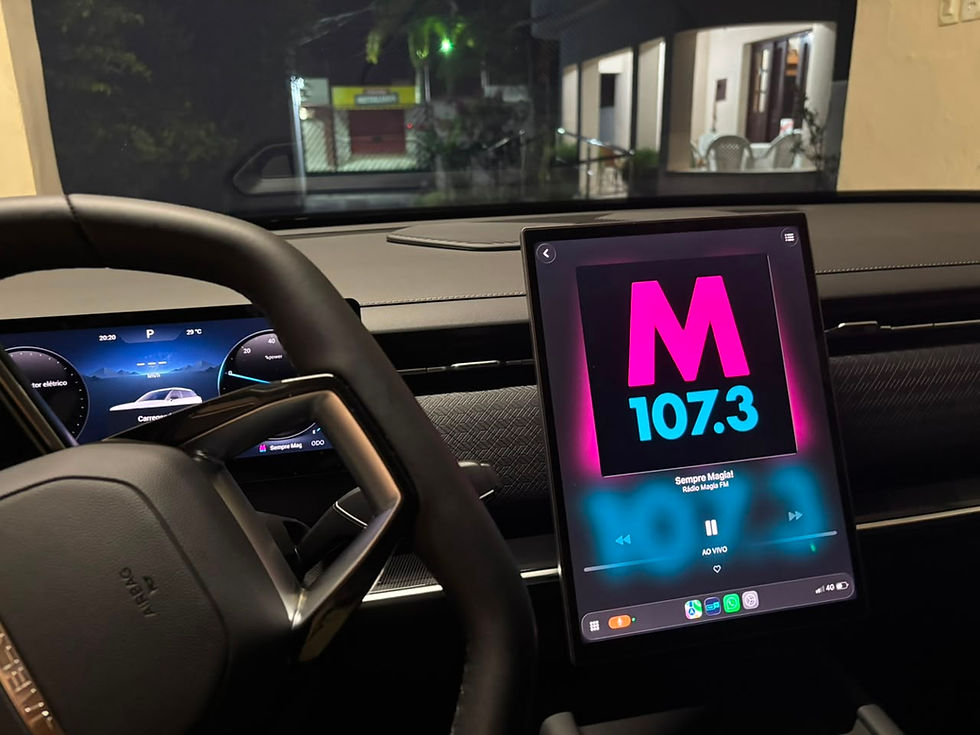
This transformation is being driven largely by the automotive industry itself. Vehicles across a wide range of market segments are already being launched with permanently connected infotainment systems capable of accessing thousands of radio stations through aggregators and dedicated applications. In many cases, consumers are not even aware that they are listening to radio over IP, as the experience is virtually identical to that of conventional radio.
This shift is occurring almost independently of regulatory authorities. No government approval is required to install a radio application in a vehicle, regulate a radio aggregation platform, or establish a specific technological standard for a broadcaster to be heard over the internet. All that is required is for the station to provide an online audio stream.
In Brazil, this process is already taking place quietly. Thousands of broadcasters simultaneously transmit over FM and the internet. Automakers continue to incorporate increasingly connected multimedia systems, while technology companies develop platforms capable of bringing together radio stations from around the world within a single interface. The expansion of this ecosystem does not depend on a public policy aimed at the digitalization of terrestrial radio.
Unlike traditional digital broadcasting models, whose expansion requires regulatory decisions and significant investments in transmission infrastructure, IP Radio evolves alongside the natural development of telecommunications. As mobile networks become faster, more reliable, and more widely available, internet radio usage expands automatically, following the broader evolution of connectivity itself.
Another decisive factor is economies of scale. Global manufacturers of automobiles, smartphones, and multimedia systems prefer to develop universal solutions compatible with any country connected to the internet rather than adapting their products to multiple national digital radio standards. This trend naturally favors IP Radio, whose operation is independent of the specific regulatory framework of each market.
This does not mean that FM broadcasting will disappear in the short term. On the contrary, it will continue to play an important role for many years, particularly during emergencies, in areas without internet coverage, and as a free, wide-area broadcasting platform. Nevertheless, the way audiences access radio content is likely to change progressively.
The emerging scenario is one of technological coexistence. FM will remain as a broadcasting infrastructure, while IP Radio is expected to establish itself as the primary listening platform for an increasingly large share of the audience, especially in connected vehicles and on mobile devices.
Within this context, the debate over which terrestrial digital radio standard Brazil should adopt loses part of its strategic significance. Even if no definitive decision is made in the coming years, the digitalization of radio consumption will continue to advance through the internet. This is a process driven by global market forces, the automotive industry, technology companies, and consumer behavior, not exclusively by broadcasting regulators.
For this reason, it is reasonable to argue that IP Radio has the potential to become the dominant digital radio system in many countries. In Brazil, its expansion is already occurring in a concrete and accelerating manner, largely beyond the direct reach of traditional broadcasting regulation.
The Ultimate Digital Radio Battle: IP Radio vs. DAB+, DRM, and HD Radio
All digital radio systems eliminate the static, hiss, and audio quality fluctuations that are characteristic of analog broadcasting. However, not all of them are equally capable of maintaining transmission efficiency over long distances. In some cases, broadcasters reduce the audio bitrate to minimize reception failures and data packet loss, sacrificing audio quality in exchange for greater signal robustness and coverage.
Coverage
IP RADIO
Virtually worldwide coverage. Signal distribution uses the already established fixed and mobile internet infrastructure. In Brazil, considering only mobile internet, practically 97% of the population is covered by 4G/5G networks.
Does not require reducing audio quality to achieve longer distances.
DAB
Coverage is limited by the deployment of an expensive infrastructure involving transmitters and repeaters.
DRM
Coverage is limited by the transmitter’s propagation range. In FM bands, coverage can be comparable to analog FM, while in AM bands it can reach much greater distances. Lower audio bitrates may be used to improve signal robustness and reception stability.
HD RADIO
Coverage is limited by the transmitter’s propagation range. In FM, digital coverage is generally comparable to analog FM, although robustness decreases near the edge of coverage. In AM, digital operation may face additional propagation and interference challenges, especially at night.
Investments and Costs for Broadcasters
IP RADIO
Does not require major additional transmission infrastructure, since broadcasters can leverage their existing streaming systems. In many cases, broadcasters already use digital audio directly from the audio processor, which is also suitable for other digital radio platforms.
IP RADIO can operate with very high audio quality without the same practical robustness limitations normally associated with terrestrial digital broadcasting systems. However, large-scale distribution may still involve costs related to bandwidth, CDN services, servers, and application maintenance.
DAB
Requires dedicated digital transmission infrastructure, including multiplexing systems, transmitters, repeaters, and related network architecture. Depending on the operational model, broadcasters may either invest directly in infrastructure or pay multiplex and transmission leasing fees.
DRM
Requires digital transmission infrastructure, including compatible transmitters, exciters, and related components for the new transmission architecture. In some cases, existing AM or FM systems may be adapted or upgraded.
HD RADIO
Requires digital transmission infrastructure, including compatible transmitters, exciters, and related transmission components. Implementation may also involve licensing costs and royalties associated with the proprietary technology.
Investments and Costs for Listeners
IP RADIO
Cars can update their existing multimedia systems and become compatible with IP RADIO.
Listeners already own compatible devices, reducing the need for dedicated radio hardware. However, reception depends on mobile internet or broadband access, which may generate ongoing costs related to data usage, subscription plans, or internet services. Battery consumption on portable devices is also typically higher compared to traditional broadcast radio reception.
Many vehicle models already include built-in internet connectivity, with some manufacturers even offering up to two years of internet access without additional subscription costs.
DAB
Requires a DAB-compatible receiver, whether as a dedicated radio, automotive receiver, or integrated chipset in consumer electronics. After purchasing the receiver, reception is free, with no recurring data or connectivity charges, since the system operates via terrestrial broadcasting.
Coverage limitations may require listeners to acquire external antennas or more advanced receivers in weak-signal areas.
DRM
Requires a DRM-compatible receiver or compatible SDR platform. Depending on the implementation model, listeners may need dedicated radios, automotive receivers, or updated devices with DRM decoding support.
After acquiring compatible equipment, reception is generally free, since the system uses terrestrial broadcasting. Availability and receiver prices may vary significantly depending on market scale and regional adoption.
HD RADIO
Requires an HD Radio-compatible receiver. After purchasing the equipment, listeners do not incur recurring internet or data costs, since reception is based on terrestrial broadcasting.
In some regions, receiver availability remains more limited compared to conventional FM radios, which may increase acquisition costs.
Deployment Time for Broadcasters
IP RADIO
By leveraging audio already transported through streaming infrastructure, broadcasters can make the service available immediately.
DAB
Requires time for importing transmitters, antennas, and other support equipment. Part of the infrastructure would likely depend on government implementation according to national coverage policies. The process may also involve repeaters or gap fillers, requiring substantial investment and deployment time.
DRM
Requires time for importing transmitters and other support equipment.
HD RADIO
Requires time for importing transmitters and other support equipment.
Deployment Time for Listeners
IP RADIO
Focusing on automotive usage as an adoption indicator, IP Radio adoption would consolidate once vehicle multimedia systems are updated to receive radio stations.
Cars connected through smartphone mirroring systems or equipped with built-in internet connectivity would represent the final stage of implementation and consolidation of the system.
This can be understood as an almost immediate implementation model already experienced by people around the world today, considering that connected cars and dedicated applications already fully emulate the radio experience.
Immediate. Most listeners already own compatible devices such as smartphones, smart TVs, computers, connected cars, and smart speakers. In many cases, no new hardware is required, only internet access and an app or browser.
DAB
Slow to medium term. Listeners require DAB-compatible receivers or compatible automotive systems. Adoption depends on the availability and affordability of receivers in the local market, as well as vehicle fleet renewal.
DRM
Slow. Requires DRM-compatible receivers, which remain relatively limited in global consumer markets outside specific regions such as India. Automotive integration and large-scale consumer adoption are still restricted.
HD RADIO
Medium to slow term. Requires HD Radio-compatible receivers. Adoption is generally linked to newer vehicle models and specific receiver imports. Outside North America, receiver availability remains relatively limited, which may delay mass adoption.
Station Availability
IP RADIO
Thousands of stations, virtually an unlimited number of local, regional, national, and international broadcasters, including both physical radio stations and purely virtual radio operations. As a result, even the number of local stations available becomes significantly larger, in addition to external stations.
DAB
Dozens of stations.
DRM
Dozens of stations.
HD RADIO
Dozens of stations.
Broadcasting License Requirements
IP RADIO
No bureaucracy or broadcasting license is required to operate.
DAB
Bureaucracy, costs, and long licensing processes.
DRM
Bureaucracy, costs, and long licensing processes.
HD RADIO
Bureaucracy, costs, and long licensing processes.
Organic Digital Radio vs Inorganic Digital Radio
In practice, we are facing a comparison between an organic digital radio system (IP RADIO), which does not depend on centralization or external incentives for expansion and scalability, and other systems that require strong consortiums, investments, and additional adoption efforts (HD RADIO, DRM, and DAB).
DELAY
In terrestrial digital radio:
DAB+ uses buffering, AAC+ encoding, multiplexing, and error correction;
DRM also uses encoding, interleaving, and processing;
HD Radio presents noticeable delay compared to hybrid analog FM.
Delay is not an exclusive characteristic of IP Radio. It is a natural consequence of modern digital processing.
In television, this has already become completely normalized.
The old analog TV had virtually instantaneous response.
Practical Reality
What defines the listener’s experience is not the existence of a few seconds of delay, but rather:
continuity of playback;
absence of failures;
ease of access;
sound quality;
availability anywhere.
That is why younger audiences practically do not consider delay a decisive factor. The generation accustomed to:
Spotify,
YouTube,
Netflix,
Twitch,
podcasts,
live streams,
sports streaming,
Small digital delays as part of the modern media ecosystem.
In many cases, streaming even offers a subjectively superior experience compared to FM:
no static;
no multipath interference;
no fading;
no distortion;
no abrupt quality variation;
maintaining consistent audio quality over hundreds or thousands of kilometers.
That is why the debate about delay is often more ideological and corporate than actually connected to real audience behavior. The average consumer simply wants to access content conveniently and reliably. Whether the audio arrives 8 or 15 seconds after FM rarely changes the actual listening experience.
IP Radio Is More Than Just Streaming ### It Represents a New Structural Distribution Model
Streaming is no longer simply a secondary retransmission of an FM broadcast. It represents a paradigm shift: the primary audio is no longer conceived as the output of a transmitter but as a primary digital stream.
This distinction is important because, from a technical standpoint, digital audio:
originates within an IP environment;
leaves the audio processor already in digital format;
can be distributed simultaneously to:
mobile applications;
connected vehicles;
smart speakers;
CDNs (Content Delivery Networks);
affiliate stations;
radio aggregators;
connected TVs;
voice assistants.
Within this model, the FM transmitter becomes just one of several possible destinations for the audio.
This is an extremely important point, and many professionals in the broadcasting industry have not yet fully realized its implications.
2. IP Radio Grows Organically
Systems such as:
DAB+;
DRM;
HD Radio;
depend on:
government regulation;
receiver manufacturing;
fleet renewal;
spectrum allocation;
transmitters;
public incentives;
industry coordination;
physical deployment.
IP Radio, on the other hand, grows by leveraging infrastructure that already exists:
existing smartphones;
connected vehicles;
Android Auto;
Apple CarPlay;
smart speakers;
already-popular applications.
This completely changes the pace of adoption.
These are two fundamentally different models:
digitalization driven by public policy;
digitalization driven by consumer behavior.
Historically, consumer-driven technologies tend to scale much faster.
3. Moving Beyond the "Synchronization Obsession"
Many hybrid FM + IP projects attempt to synchronize both signals down to the millisecond in order to enable seamless switching between:
FM;
internet streaming;
terrestrial digital radio.
The problem is that this dramatically increases:
system complexity;
costs;
processing requirements;
buffering;
network architecture complexity.
This raises a legitimate question: does the average listener actually care whether a song starts a few seconds later?
In the overwhelming majority of cases, the answer is no.
The obsession with perfect synchronization comes far more from:
broadcast engineers;
equipment manufacturers;
industry standards;
technological competition;
than from actual consumer experience.
A similar phenomenon occurred during the transition to digital television, where audiences naturally accepted delays far greater than those typically found in radio.
4. FM Is Neither Perfect nor Universally Superior
Many FM enthusiasts overlook this reality.
FM broadcasting has well-known technical limitations, including:
multipath propagation;
signal reflections;
fading;
background noise;
distortion;
gradual signal degradation;
inconsistent urban coverage;
interference.
In complex urban environments, streaming often delivers more stable audio than FM.
This is already the case in many cities.
The traditional argument that broadcasting is inherently more robust begins to lose strength in areas where:
4G and 5G networks are extremely dense;
continuous mobile data coverage exists;
efficient handoff mechanisms are available;
mobile networks offer massive redundancy.
In certain metropolitan environments, modern cellular infrastructure has already become more robust than portions of the local FM broadcasting infrastructure.
5. The Concept of the "Infinite Dial"
Perhaps this is the most disruptive concept of all.
Historically, the radio dial has always been limited by:
geography;
signal propagation;
transmitter power;
available spectrum.
With IP Radio, the dial is no longer spectrum-based—it becomes logical.
This completely transforms:
competition;
audience reach;
market segmentation;
niche programming;
advertising markets;
regional identity;
international expansion.
A local station in Natal can compete on a global scale.
A station from New York can be heard in the countryside of Northeastern Brazil.
Radio becomes much closer to:
music streaming services;
on-demand platforms;
global audio ecosystems.
Consumer Behavior Has No Reverse Gear
New generations have already normalized consuming media through IP networks.
For people accustomed to:
Spotify;
YouTube;
TikTok;
podcasts;
live streaming;
sports streaming;
the idea of tuning a frequency increasingly feels outdated.
Consumer behavior is shifting from "searching for a frequency" to simply "asking for content."
This is probably the greatest structural disruption facing traditional broadcasting.
A Different Philosophy
This is not simply a defense of streaming.
It proposes a philosophical shift: radio evolving from a spectrum-based technology into a globally distributed digital audio platform.
At the core of this idea is the notion that radio is gradually migrating from a frequency-centered ecosystem to one centered on connectivity.
From Another Post I Recently Wrote
AlexCAR InfiniteDial:
Twenty Radio Stations with Reliable Reception Within 40 km or Twenty Thousand Stations with Unlimited Coverage and Perfect Audio
There are now two distinct ecosystems for radio.
The first relies primarily on an FM transmitter, delivering analog audio that naturally degrades as the listener moves farther away from the transmission source.
The second uses the digital audio output directly from the station's audio processor. Instead of feeding a single transmitter, this audio is sent into an IP-based redundancy and distribution environment.
The stream may range from 48 kbps AAC+ to well over 256 kbps AAC+, already providing, even at lower bitrates, audio quality superior to that obtained by receiving an FM signal and subsequently encoding it into 64 kbps AAC+ (48 kHz).
Within this ecosystem, every existing FM station can also provide a digital audio stream.
This does not reduce a station's coverage, it expands it globally while preserving high-quality audio without progressive degradation.
Imagine getting into your car and saying: "Car, play Jovem Pan Natal."
The vehicle would perform a relatively simple task.
First, it would check whether the station provides at least a 48 kbps AAC+ stream.
If available, that digital stream would become the primary audio source.
If, for any reason, the digital stream were unavailable, the system would automatically switch to the FM broadcast.
Either way, the listener would still be listening to radio.
Whether the manufacturers of yesterday's "typewriters" like it or not, geographically unrestricted digital audio is arriving.
Does this threaten radio? No.
It expands the reach of well-managed radio stations—but not every station will necessarily benefit.
Some groups may dislike the prediction that IP Radio is becoming inevitable.
However, this transformation does not depend on any individual, nor can it realistically be stopped.
The future is likely to look exactly like this:
Driving through the Brazilian Northeast between Caicó and Natal while asking your car to play New York's Z100.
Or driving through northern France and asking your vehicle to play Jovem Pan Natal, a station from northeastern Brazil.
And when will this technology become available?
Perhaps tomorrow.
In reality, much of it already exists today.
It follows exactly the same principle as asking an Alexa speaker to play a particular radio station.
Alexa does not tune between 76 and 108 MHz.
Instead, it accesses platforms such as TuneIn or RadiosNet.
The next logical step is simply turning that concept into an "AlexaCar."
Some Important Considerations
I do not agree with the idea that FM should always be the preferred source, with IP used only after the terrestrial signal fails.
In practice, IP is already more widely available and often more reliable, than FM, especially in large metropolitan areas.
Numerous locations experience FM interference and the well-known multipath effect, producing distortion even just a few kilometers from the transmitter.
In Natal, for example, several stations suffer noticeable audio degradation in the Tirol district because of reflections and interference.
Outside major metropolitan areas, the situation often favors IP even more
In many smaller cities, 4G and 5G coverage is considerably stronger and more consistent than local FM reception.
In such environments, continuous IP reception is frequently easier than reliable terrestrial radio reception.
I also disagree with the idea of instant automatic switching between analog and digital signals whenever signal strength fluctuates.
Nothing is more distracting than a system constantly alternating between analog and digital audio:
muffled sound...
clear sound...
muffled again...
clear again...
The audio quality difference between the two environments is simply too large for this constant "ping-pong" effect to go unnoticed
Another point I question is the industry's obsession with millisecond-level synchronization between digital and analog audio.
This is precisely what makes hybrid systems unnecessarily expensive and complex.
As mentioned earlier, for the average listener, it makes little or no difference whether a Bruno Mars song begins at 9:23:12 or at 9:23:45.
Digital audio naturally introduces some delay, but that is largely irrelevant to ordinary listeners.
Extreme synchronization only becomes necessary to support constant instantaneous switching between FM and IP.
A more rational approach would be straightforward:
IP should be the preferred audio source!
The system should switch to FM only if the digital stream remains unavailable for more than 30 consecutive seconds.
Furthermore, today it is generally far more common to experience degraded or absent FM reception than a complete loss of IP connectivity.
My proposal is simple:
Streaming should become the primary audio source, while FM should function only as an automatic redundancy mechanism in the event of a prolonged loss of the digital stream.
Digital Radio: An Open-Source "Anarchist" System Could Surpass HD Radio, DRM, and DAB Across Much of the World
The concept is remarkably simple. Imagine being able to send your station's digital audio directly from the digital output of its audio processor to any listener in the world who wants to hear it. Would you need to purchase a new transmitter? No. Would listeners need to buy a new digital receiver? No again. Nothing beyond the equipment they already own. I will explain the details shortly.
If broadcasters do not have to invest millions in new digital transmitters to deliver high-quality audio, and listeners do not have to spend hundreds of dollars, euros, or reais on compatible receivers, what incentive remains to keep systems such as HD Radio, DRM, or DAB economically competitive?
In other words, if an open, low-cost, decentralized digital system can deliver comparable or even superior audio quality using infrastructure that already exists, it becomes increasingly difficult to justify the economics of standards that require substantial investments from both broadcasters and listeners.
Some digital broadcasting systems operate with relatively low audio quality settings, which ultimately contradicts one of the fundamental goals of digitalization: delivering state-of-the-art sound quality.
This happens because the robustness of conventional digital radio systems generally decreases as higher bitrates are used. In general, the higher the bitrate, the greater the fidelity of the transmitted audio. However, higher bitrates also increase the amount of information that must be correctly received and decoded, making the signal more susceptible to data loss over long distances or under unfavorable propagation conditions.
As a result, reception errors may cause interruptions, dropouts, or audio glitches. To minimize these problems, broadcasters often reduce the bitrate and consequently the audio quality, thereby decreasing the amount of data that must be transmitted in order to maintain a stable and intelligible signal.
The Open-Source, Decentralized Digital Radio System
Imagine getting into your car and saying: "Car, play Jovem Pan Natal."
Even if you are driving along Paulista Avenue in São Paulo, you would immediately hear Jovem Pan Natal with audio quality superior to that of any analog FM station available in the city.
Skeptical? Then try it yourself!
While standing on Paulista Avenue, open the RadiosNet app, select Jovem Pan Natal, and start listening.
The result will be exactly as described: a radio station located more than 2,000 kilometers away arriving with digital-quality audio and without the propagation limitations of conventional terrestrial broadcasting.
"But Ricardo, you said all I would have to do is get into the car and ask it to play the station."
Yes, I did.
And in practical terms, what is the difference between mirroring your smartphone through Apple CarPlay or Android Auto and selecting Natal's 99.5 FM in the RadiosNet app?
Simply the existence of a native application installed directly in the vehicle's infotainment system and connected to the internet.
Doesn't This Technology Still Need to Be Invented?
Actually, in many cases it already exists, and it is rapidly becoming commonplace.
Modern vehicles are leaving the factory equipped with sophisticated infotainment systems, built-in connectivity, integrated applications, and permanent internet access.
Many automakers already include mobile data plans that remain active for months or even years after the vehicle is purchased.
In other words, the infrastructure required for this so-called "anarchist digital radio" is already being deployed by the automotive industry itself.
This is neither futuristic technology nor something that depends on a technological revolution.
It is simply the natural evolution of systems that already exist.
What once required high-power transmitters, licensed radio frequencies, and specialized receivers can increasingly be accomplished through a simple internet connection and open-source software.
1#The necessary technology already exists.
2#The only remaining question is adoption.
But the Internet Isn't Available Everywhere!
One of the most common criticisms of this model is straightforward:
"But the internet isn't available everywhere."
The reality, however, is that conventional digital radio systems face even greater limitations.
In the United States, for example, HD Radio often struggles to maintain consistent reception even in major metropolitan areas, where physical obstacles, interference, and signal degradation affect coverage in certain locations.
IP Radio, by contrast, operates on an entirely different infrastructure.
The São Paulo metropolitan area alone is served by hundreds of cellular towers transmitting 3G, 4G, and 5G signals. In a sense, each of these towers can be viewed as a potential repeater for thousands of radio stations simultaneously.
As a result, its coverage already surpasses that of any terrestrial digital radio system deployed to date, whether HD Radio, DRM, or DAB.
Whereas a conventional digital radio station depends exclusively on its own transmission network, IP Radio takes advantage of a nationwide telecommunications infrastructure that is already in place and continuously expanded by mobile network operators.
In practical terms, I have personally driven approximately one hundred kilometers from Natal while listening to my favorite station via streaming.
During nearly two hours of travel, I lost the signal for only about 40 to 50 seconds in total.
That level of coverage would be difficult for many terrestrial digital radio systems to match.
Looking at today's reality, it is difficult to find a medium-sized Brazilian city without mobile internet coverage.
Even in small municipalities, there is usually at least one operator providing network access.
By contrast, there are many places where FM reception suffers from weak signals, interference, or simply fails to reach certain areas.
For this reason, when discussing coverage, the internet is no longer the primary limitation.
In many regions, it already offers broader and denser coverage than traditional broadcasting networks themselves, making it a naturally favorable platform for large-scale digital audio distribution.
Is There Any Difference Between the Audio Quality of HD Radio, DRM, DAB, and IP Radio?
From an audio quality standpoint, IP Radio has the potential to outperform all of them, because it is not constrained to operate at low bitrates.
All of these systems begin with exactly the same source: the digital audio generated by the radio station, typically taken directly from the digital output of the station's audio processor.
In other words, the raw audio material is essentially identical, regardless of whether its destination is an HD Radio transmitter, a DRM transmitter, a DAB multiplex, or an IP Radio platform.
A broadcaster choosing to stream at 128 kbps using modern codecs such as AAC+ can deliver audio quality capable of exceeding that of many HD Radio broadcasts currently operating in the United States.
The result can be exceptionally clean audio, with excellent frequency response and very few audible compression artifacts.
Naturally, a station lacking basic technical expertise may improperly configure its audio processing, choose insufficient bitrates, or apply poor encoding parameters, compromising the final result.
However, those are implementation issues not technological limitations.
Perhaps the most interesting aspect is that achieving high audio quality with IP Radio requires very little additional investment.
If a broadcaster already owns a modern audio processor with a digital output—which would also be necessary for HD Radio, DRM, or DAB, the additional cost of making that same high-quality audio available over the internet is almost negligible.
Therefore, when the discussion is limited to sound quality alone, it becomes difficult to argue that terrestrial digital radio systems possess any inherent advantage over IP Radio.
In practice, both can deliver outstanding audio quality.
The real distinction lies in the distribution infrastructure rather than in the quality of the audio itself.
What If IP Radio Receivers Used Real Antennas Instead of Today's Small Built-In Ones?
There is another issue that receives surprisingly little attention.
Most devices currently used for IP Radio such as smartphones and tablets operate with extremely compact antennas designed to fit inside portable electronics.
Despite this physical limitation, they are still capable of receiving 3G, 4G, and 5G signals well enough to deliver high-quality digital audio.
But what would happen if future IP Radio receivers were equipped with larger antennas and more sophisticated receiving systems?
It is worth remembering that smartphones operate with only the minimum antenna performance necessary to receive a signal.
A vehicle, on the other hand, can employ much larger external antennas mounted in optimal locations on the body and connected to more sensitive, higher-performance receiving modules.
In practice, a dedicated IP Radio receiver installed in a vehicle could achieve reception performance significantly superior to that of an ordinary smartphone.
That would translate into greater connection stability, fewer interruptions, and more efficient use of the existing mobile network infrastructure.
From this perspective, the argument that IP Radio depends solely on tiny antennas becomes much less convincing.
Today's technology already performs remarkably well with compact antennas.
If dedicated receivers equipped with higher-gain antennas and advanced reception systems become available in the future, the natural outcome will be even greater practical coverage and improved service robustness.
In other words, IP Radio already delivers impressive results using minimal antenna systems.
With higher-gain antennas and receivers specifically engineered for this purpose, its overall performance is likely to become even better.
Who Will Take the First Step Toward This System?
In practice, it is of little use for supporters of HD Radio, DRM, or DAB to hope that this model never emerges. The barrier to entry is simply too low.
At any moment, an automaker could introduce an infotainment system featuring a native IP Radio application, integrated with voice commands and connected to high-performance antennas capable of receiving 3G, 4G, and 5G signals. The result would be a digital radio system that is robust, global, and remarkably easy to use.
Automakers, however, are not the only players capable of driving this transformation. Infotainment system manufacturers, professional audio companies, independent developers, startups, and even open-source software communities possess the technical expertise required to build similar solutions. Because this is an open model built upon infrastructure that already exists, there is no single organization capable of controlling or preventing its expansion.
This is precisely why the concept can be described as "anarchist." It does not rely on a central authority, a specific technology license, or a proprietary standard controlled by a handful of market participants. Any individual or company can develop its own implementation.
In this environment, traditional hybrid radio systems would struggle to compete. While conventional digital broadcasting systems remain constrained by geographic coverage, spectrum availability, and the finite number of stations accessible in any given region, IP Radio operates without conventional tuning, without borders, and with virtually no practical limits on content availability.
Listeners no longer have to choose from only a few dozen local stations. Instead, they gain immediate access to thousands of radio stations from around the world. Unlike terrestrial digital broadcasting systems, whose audio quality may vary depending on received signal strength, IP Radio is capable of delivering a consistent listening experience whenever adequate internet connectivity is available.
From a coverage standpoint, the advantages are equally significant. Brazil's large and medium-sized cities as well as most of the highways connecting them, already served by an extensive mobile telecommunications infrastructure. Millions of users rely on these networks every day for applications that consume far more bandwidth than a simple audio stream.
This does not mean that every location is covered or that coverage gaps no longer exist. Nevertheless, it is difficult to ignore the fact that today's telecommunications infrastructure has reached a level of geographic coverage that no terrestrial digital radio system has managed to replicate on a global scale.
If the infrastructure already exists, if compatible receivers are already in the hands of consumers, and if the necessary software can be developed by any company or open-source community, then perhaps the real question is no longer whether this model will emerge, but when it will become the dominant platform for digital radio.