A New Digital Radio System: No Tuning, No Sync — An Anarchist, Open Source and Low Cost System

The concept is remarkably simple. Imagine being able to send your station's digital audio directly from the audio processor output to any listener in the world who wants to hear it. Do you need to buy a new transmitter? No. Does the listener need to purchase a new digital receiver? No. Nothing beyond the equipment they already have today. I will explain further ahead.
If broadcasters do not need to invest millions in a new digital transmitter to deliver high quality digital audio, and listeners do not need to spend hundreds of dollars, euros, or reais on a compatible receiver, what incentive remains to keep systems such as HD Radio, DRM, or DAB competitive?
In other words, if an open, low cost, anarchist digital system can deliver comparable or even superior performance using infrastructure that already exists, it becomes difficult to justify the economic adoption of standards that require substantial investments from both broadcasters and listeners.
The Open Source Anarchist Digital Radio System
Imagine getting into your car and saying, "Car, play Jovem Pan Natal." Even if you are driving down Paulista Avenue in São Paulo, you would immediately hear Jovem Pan Natal with audio quality superior to any analog FM station available in the city.
Doubt it? Try it yourself. While standing on Paulista Avenue, open the RadiosNet application, select Jovem Pan Natal, and listen. The result will be exactly that: a station located more than 2,000 kilometers away arriving with digital quality and without the limitations of conventional radio propagation.
"But Ricardo, you said I could simply get into my car and ask it to play the station."
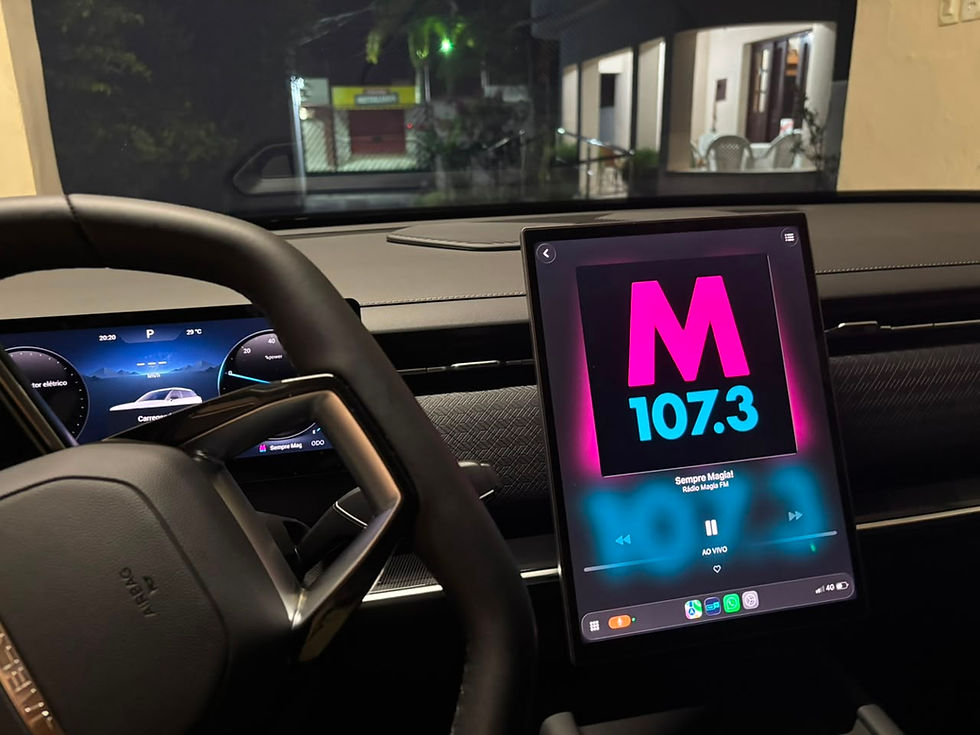
Yes, I did. And what is the practical difference between mirroring your phone through CarPlay or Android Auto and selecting 99.5 FM Natal on RadiosNet? Only the presence of a native application installed directly in the vehicle's multimedia system and connected to the internet.
Does that not exist yet?
Actually, in many cases it already does, and it is rapidly becoming commonplace. Vehicles are leaving the factory with advanced multimedia systems, built in connectivity, integrated applications, and permanent internet access. Many manufacturers already include data plans for months or even years after the vehicle is purchased.
In other words, the infrastructure required for what I call "anarchist digital radio" is already being deployed by the automotive industry itself. This is not a futuristic technology, nor does it require a technical revolution. It is simply the natural evolution of systems that already exist.
What once required high power transmitters, licensed frequencies, and specialized receivers can increasingly be accomplished through a simple internet connection and open source software. The technology already exists. The rest is merely a matter of adoption.
But Internet Coverage Is Not Available Everywhere
One of the most common criticisms of this model is simple: "Internet is not available everywhere."
The issue is that traditional digital radio systems face similar limitations, and often even more severe ones. In the United States, HD Radio has struggled to maintain consistent reception even in large metropolitan areas, facing physical obstacles, interference, and signal degradation in certain locations.
IP Radio operates on a completely different infrastructure. In the São Paulo metropolitan area alone, there are hundreds of cellular towers transmitting 3G, 4G, and 5G signals. In a sense, each of those towers can be viewed as a repeater capable of delivering thousands of radio stations simultaneously.
Coverage therefore begins at a level superior to any terrestrial digital radio system deployed so far, whether HD Radio, DRM, or DAB. While a conventional digital station depends exclusively on its own transmission network, IP Radio relies on a nationwide telecommunications infrastructure that is already installed and constantly expanding.
Personally, I have traveled roughly one hundred kilometers from Natal while listening to my favorite station via streaming. During nearly two hours of driving, I lost the signal for only forty or fifty seconds in total. That level of coverage would be difficult for many terrestrial digital radio systems to match.
If we examine current reality, it is difficult to find a medium sized Brazilian city without mobile internet coverage. Even in small municipalities, there is usually at least one operator providing access. By contrast, there are many locations where FM signals are weak, inconsistent, or fail to reach certain areas altogether.
For that reason, internet connectivity is no longer the primary limitation when discussing coverage. In many regions, it already offers greater reach than traditional broadcasting networks themselves, making it a natural platform for large scale digital audio distribution.
Is There a Difference Between HD Radio, DRM, DAB, and IP Radio Audio?
From a sound quality perspective, IP Radio can surpass all of them because it does not necessarily need to operate at low bit rates.
All of these systems are fed from the same source: the digital audio generated by the station, usually delivered through the digital output of the audio processor. In other words, the raw audio material is essentially identical regardless of whether the destination is HD Radio, DRM, DAB, or an IP Radio platform.
A station that chooses to stream at 128 kbps using modern codecs such as AAC Plus can deliver audio quality capable of surpassing a significant portion of current HD Radio broadcasts in the United States. The result can be exceptionally clean audio with excellent frequency response and minimal audible artifacts.
Naturally, a broadcaster lacking technical expertise can configure processing incorrectly, use insufficient bit rates, or adopt poor encoding parameters, compromising the final result. However, that is an implementation problem, not a limitation of the technology itself.
Perhaps the most interesting aspect is that achieving high audio quality through IP Radio requires very little additional investment. If a station already owns a modern audio processor with digital output, something that would also be necessary for HD Radio, DRM, or DAB, then the cost of distributing that same audio through the internet at high quality is practically negligible.
When the discussion is limited to audio quality, it becomes difficult to argue that terrestrial digital radio systems possess any inherent advantage over IP Radio. Both can deliver excellent sound quality. The difference lies primarily in the distribution infrastructure rather than in the sound itself.
What If IP Radio Receivers Used Real Antennas?
There is another issue that is rarely discussed. Most devices currently used for IP Radio, such as smartphones and tablets, operate with extremely compact antennas designed to fit inside portable devices. Despite this physical limitation, they are still capable of receiving 3G, 4G, and 5G signals well enough to support high quality digital audio.
But what would happen if dedicated IP Radio receivers were equipped with larger antennas and more sophisticated reception systems?
We should remember that smartphones operate with the bare minimum necessary to receive a signal. By contrast, automobiles can be equipped with much larger external antennas mounted in optimal locations and connected to more sensitive communication modules.
In practice, a dedicated IP Radio receiver installed in a vehicle could provide reception performance significantly better than that of an ordinary smartphone. This translates into greater connection stability, fewer interruptions, and better utilization of existing mobile network infrastructure.
From this perspective, the argument that IP Radio depends solely on tiny antennas becomes less convincing. The technology already works well with compact antennas. If dedicated receivers equipped with higher gain antennas and advanced reception systems emerge in the future, practical coverage and service robustness are likely to improve even further.
Who Will Launch This System?
In reality, supporters of HD Radio, DRM, or DAB cannot simply hope that such a model never emerges. The barriers to entry are simply too low.
At any moment, an automobile manufacturer could release a multimedia system with a native IP Radio application integrated with voice commands and connected to high performance 3G, 4G, and 5G reception systems. Instantly, a robust, global, and remarkably simple digital radio platform would exist.
And it is not only automobile manufacturers that could lead this movement. Multimedia system developers, audio companies, independent programmers, startups, and even open source communities possess the technical capacity to build similar solutions. Because the model is open and based on infrastructure that already exists, no single entity can control or prevent its expansion.
That is precisely why this concept can be described as "anarchist." It does not depend on a central authority, a specific technology license, or a proprietary standard controlled by a small group of stakeholders. Anyone can develop their own implementation.
In this environment, traditional hybrid radio systems would face serious challenges. While conventional systems remain constrained by geographic coverage, frequency availability, and a finite number of stations, IP Radio operates without conventional tuning, without borders, and without practical limits on station availability.
Listeners are no longer restricted to a few dozen local stations. They gain immediate access to thousands of stations from around the world. Unlike terrestrial digital systems, whose quality can fluctuate depending on signal strength, IP Radio can deliver a consistent listening experience whenever adequate connectivity is available.
From a coverage standpoint, the advantage is equally significant. Large and medium sized Brazilian cities, as well as the highways connecting them, are already served by extensive mobile network infrastructure. Millions of people use these networks every day for applications that require far more data than audio streaming.
This does not mean that every location is covered or that dead zones do not exist. However, it is difficult to ignore that today's telecommunications infrastructure has achieved a level of reach that no terrestrial digital radio system has managed to reproduce on a global scale.
If the infrastructure already exists, if the receivers already exist, and if the software can be developed by any company or open source community, then perhaps the question is not whether this model will emerge, but when it will become dominant.