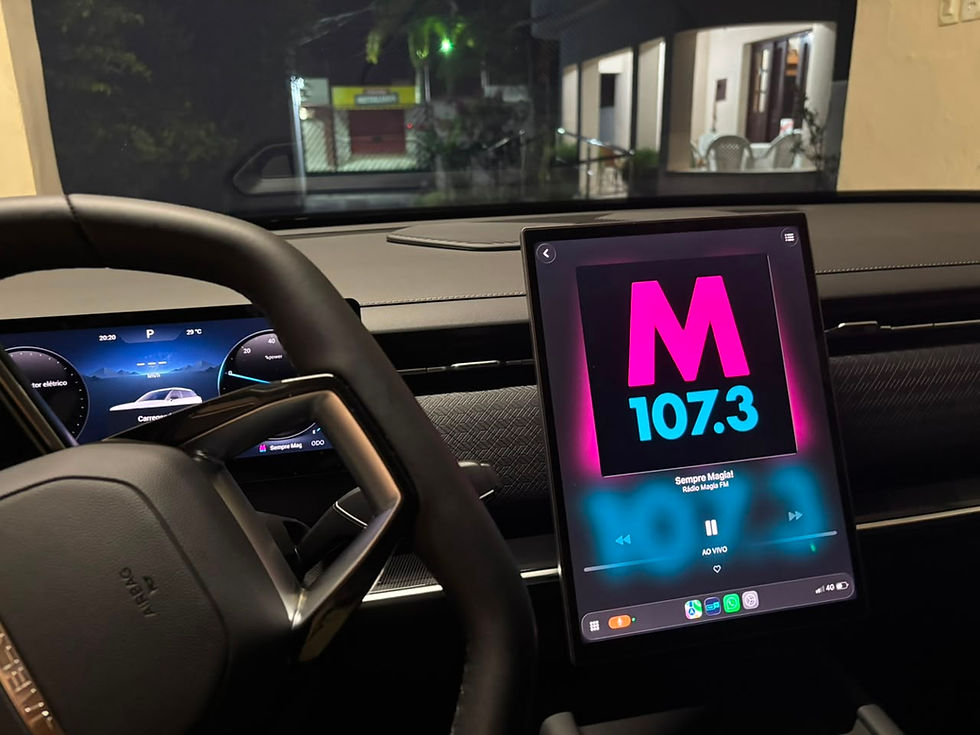
Chinese automotive giant expected to adopt native IP Radio in its vehicles, providing access to more than 50,000 digital radio stations with audio quality superior to Brazil's analog FM

The fact that Brazil still does not have a digital radio system places the country in a technological vacuum. Paradoxically, this may actually become an advantage, as it creates the opportunity to adopt the most efficient system, with greater coverage and the ability to offer listeners a much larger number of radio stations.
Content
Something beyond Spotify. More than just music, it delivers local, regional, and international news and sports, while allowing radio hosts to interact with their audiences in real time.
Versions – Two Access Modes
SCREEN: Easy radio station selection at your fingertips.
VOICE: Radio activated through voice commands.
Local Radio Stations – Will listening to a local station still be primarily through FM?
No. Even if the FM broadcast itself provides much better audio quality in digital mode, free from hiss and interference, with the IP RADIO option offered by the vehicle, you will be able to listen to a station located just 2 km away. Since the transmission is digital, audio quality will not be affected by physical obstacles such as parking garages, shopping malls, or buildings.
A Natural Forecast
As already discussed here on the blog, the solution is quite obvious and is likely to follow exactly what we predicted in previous articles: IP Radio Will Become the Dominant Digital Radio System in Many Countries; in Brazil, Its Proliferation Is Already Taking Place Beyond Regulatory Control, and A New Digital Radio System: No Tuning, No Sync ... An Anarchist, Open Source and Low Cost System
In practical terms, the vehicle's display will feature either a native IP RADIO system or a third-party platform, allowing you to select virtually any radio station in Brazil or anywhere else in the world with digital audio quality.
IP RADIO is simply the popular radio and web radio streaming system. In general, many stations already operate with audio configurations that deliver significantly better sound quality than a conventional FM transmitter. Because it is digital, it does not suffer from the frequency limitations of FM, such as the high-frequency cutoff above 15 kHz or the low-frequency roll-off below approximately 50–30 Hz.
What if this automaker were not the first to implement the native system?
Naturally, many people are already using this system on their own. Indeed, it is such a natural and trivial solution that many users simply route applications such as TuneIn or RádiosNet through Apple CarPlay or Android Auto, gaining access to more than 50,000 radio stations to follow their favorite sports teams, stay informed with the latest news, participate in local discussions, or simply enjoy music.
Therefore, if this automaker does not pioneer the implementation, another one will do so in the near future. Whoever signs off on the idea first will be remembered as the company that brought digital radio to Brazil.

The image above is for illustrative purposes only
Well, my name is Ricardo Gurgel. I am Brazilian, a civil engineer, and I am also on the verge of completing my degree in Psychology. Perhaps that explains my strong investigative mindset.
For quite some time, I have been closely studying the many factors that have prevented digital radio systems from becoming widely adopted around the world. Through this work, I was able to identify, even for myself, the path by which digital radio could finally reach the public in a simple, natural, and seamless way. Today, I believe I am very close to seeing that prediction become a reality.
Coverage Area: It is worth noting that satellite connectivity for mobile phones is already underway in Brazil, which will eliminate traditional connectivity barriers. This will combine the "infinite dial" of IP Radio with the "borderless connectivity" provided by satellite communications.
Furthermore, since this is an installation in automobiles, the receiving antennas will not be constrained by the size limitations of a smartphone. Vehicles can accommodate a more sophisticated and efficient internet reception system, capable of operating through both terrestrial 4G and 5G networks and satellite connections using other frequency bands.
Even if this still takes some time to become widespread, I have already experienced listening to the same radio station via IP Radio while traveling from Natal to the central region of the state, covering a distance of more than 150 km (93 miles). During the trip, I lost the signal for less than 3 minutes, enjoying nearly two hours of high-quality audio. It is worth emphasizing that this experience took place in one of Brazil's poorest states, where one would reasonably expect the coverage of terrestrial 4G and 5G networks to be far from ideal.