
The Effort for Radio 3.0 Is Urgent, but the Hybrid System Will Ultimately Be Consumed by Its Own Connected DNA
- Ricardo Gurgel

- há 4 dias
- 7 min de leitura
Radio 3.0 represents the convergence of FM broadcasting and internet streaming. It is not limited to audio alone. Text, images, and video can also be delivered over the internet, since streaming relies on that very infrastructure. The goal is to integrate traditional radio with the digital environment.
However, this concept contains an inherent contradiction. As soon as the system gains widespread adoption, it will naturally encourage listeners to go beyond its original purpose. People will not be satisfied with simply listening to local FM stations enhanced by digital features, as envisioned by Radio 3.0. They will want the same effortless access to any radio station in the world that offers an online stream, without geographic limitations,
IP blocking, or artificial restrictions.
Another weakness of Radio 3.0 is its preference for analog audio. By default, the system delivers the traditional FM sound, limited by the typical frequency response of analog broadcasting and subject to noise, multipath interference, and fluctuations in signal quality. Only when the analog signal deteriorates does the receiver switch to the digital stream, providing high fidelity audio with no noise, no FM bandwidth limitations, and far greater stability.
In practice, this creates a paradoxical listening experience. While listeners remain close to the transmitter, they receive analog audio. As they move farther away and the FM signal weakens, they suddenly hear a much better sounding digital stream delivered over IP.
Once this experience becomes common, listeners will quickly realize that their favorite station actually sounds better when the FM signal is poor. This will create a new expectation. They will stop preferring analog audio and instead expect digital audio all the time, with cleaner sound, greater dynamic range, wider frequency response, and none of the inherent imperfections of analog broadcasting.
This Is How Radio IP Will Emerge
This shift in listener behavior will naturally create opportunities for independent developers to satisfy the demand for continuous high fidelity audio, eliminating the annoying switching process and the noticeable difference in quality between analog FM and AAC+ streaming. The result is a much simpler solution capable of delivering a continuous, stable, fully digital listening experience with virtually unlimited station availability: Pure Radio IP.
What is most remarkable is that Pure Radio IP is significantly simpler than the far more complex Radio 3.0. It requires less hardware, less software, eliminates the need for FM receivers, and removes the entire switching logic between analog and digital transmission. As a result, its native implementation in vehicles is likely to be much simpler, while also providing a more intuitive experience for listeners.
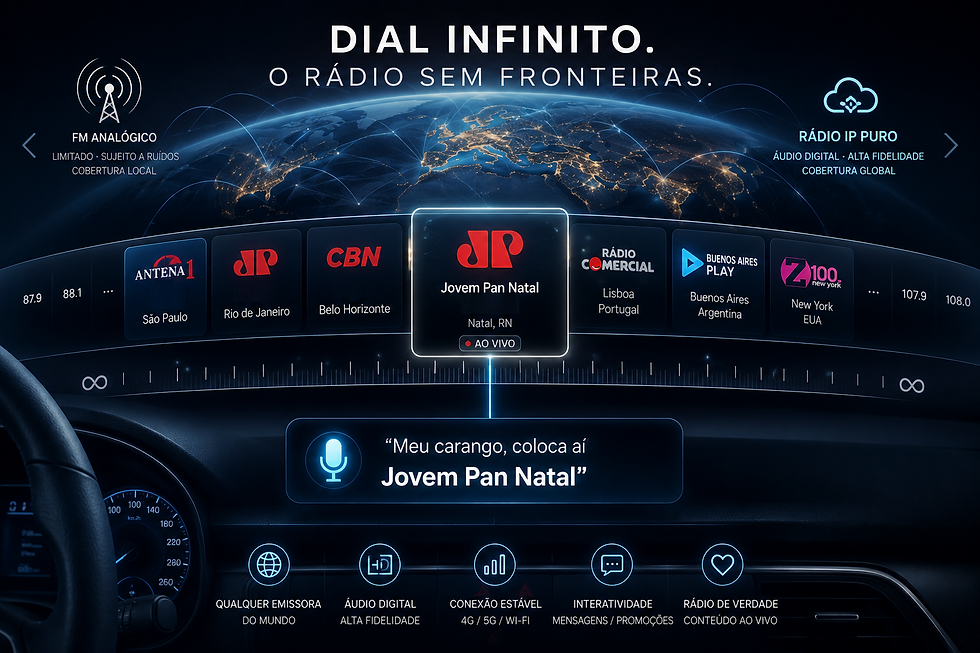
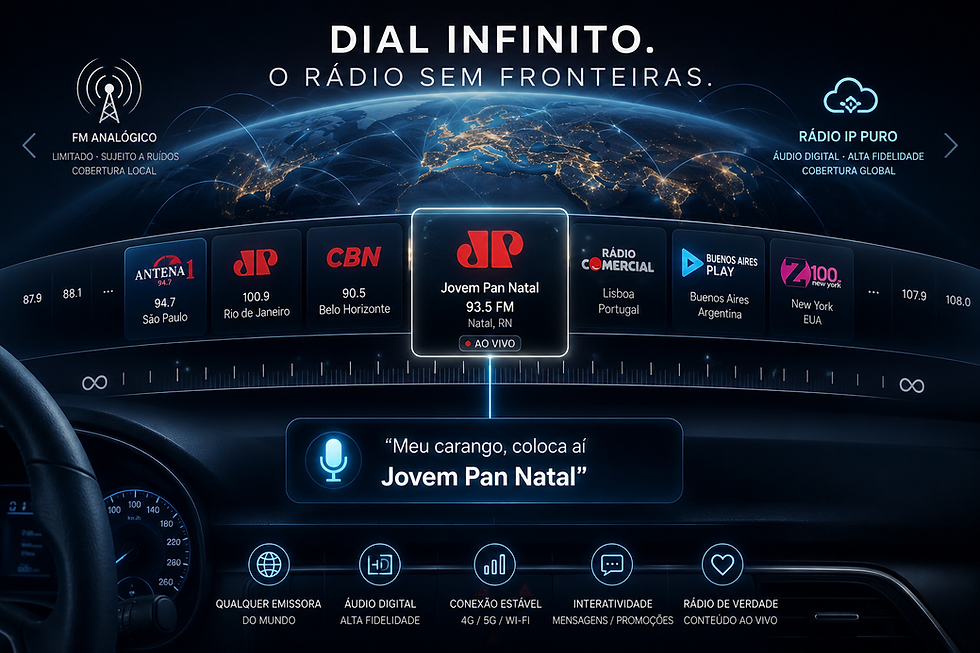
In practice, accessing any radio station in the world could be as simple as using a voice command. There would be no need to remember frequencies, manually tune the receiver, or even know where the station is located. The listener would simply say the station's name, and the system would automatically find and play its live stream, creating an experience that is far more intuitive, modern, and consistent with the way people already consume digital content today.
Imagine a simple scenario.
You are driving through João Pessoa and say to your car:
"Hey car, play Jovem Pan Natal."
Within seconds, the system automatically finds the station's live stream and playback begins. Throughout the entire drive to Recife, you continue listening to your favorite radio station in high quality, without searching for a new frequency, without static, and without the coverage limitations of FM broadcasting.
When you arrive in Recife, all you have to do is give another voice command:
"Hey car, play Z100 New York."
Once again, your request is instantly fulfilled. Geography is no longer a barrier. Radio is wherever the listener is, not wherever the transmitter can reach.
So what is the difference between this and Spotify?
The difference is that radio remains radio.
While music streaming platforms primarily deliver songs on demand, radio delivers live content: live sports coverage (and after the last World Cup, it is difficult to argue that latency is still a decisive issue), talk shows, opinion programs, local, regional, and international news, public service announcements, emergency coverage, and, above all, the human companionship provided by real presenters.
Connectivity also enables an unprecedented level of interaction. Using voice commands, listeners will be able to say:
"Hey car, send a message to the radio host."
Or:
"Hey car, I want to enter the station's promotion."
Within seconds, the message is sent directly to the station, preserving the essence of radio: real time interaction between broadcasters and their audience.
The result is an experience that combines the best of both worlds: the global reach and freedom of streaming with the spontaneity, interaction, and live programming that have always made radio a unique medium.
The transition is almost inevitable
Radio 3.0 introduces streaming to the public.
Radio 3.0 combines FM broadcasting and IP connectivity, familiarizing listeners with digital delivery.
Listeners discover that digital audio sounds better than FM.
Whenever the receiver switches to the IP stream, the digital feed taken directly from the audio processor delivers noticeably higher fidelity than the analog FM signal.
Listeners begin to expect that quality all the time.
Once they experience uninterrupted digital audio, they naturally prefer it over analog reception.
Radio IP satisfies that expectation with a much simpler architecture.
Unlike Radio 3.0, Radio IP does not require an FM receiver or the complex switching logic between analog and digital transmission. At its core, it is simply a streaming player connected to the internet.
As a result, Radio 3.0 may unintentionally encourage the adoption of its own successor.
As vehicles become increasingly connected, Radio 3.0 familiarizes listeners with voice commands, digital audio, and station selection by name rather than by frequency. In doing so, it creates the ideal conditions for the emergence of Pure Radio IP as the next logical step in the evolution of radio.
What Makes the Emergence of Independent Radio IP Developers Almost Inevitable?
The primary reason is the simplicity of the solution.
Radio IP does not depend on receiving the FM broadcast band (76.1 to 108 MHz). The entire listening experience can be built exclusively on digital distribution, centered around an internet connected streaming player. This dramatically reduces both hardware and software complexity when compared to a hybrid system that must integrate analog reception, signal processing, and seamless switching between FM and IP.
Furthermore, it is highly unlikely that vehicle connectivity will cease to be a standard feature. Automakers are moving toward offering built in internet access either free of charge or through affordable subscription plans, much like many connected services available today. Even when embedded connectivity is not available, users can simply share their smartphone's internet connection with the vehicle via WiFi or Bluetooth, exactly as many drivers already do today. This trend is unlikely to reverse.
A clear example was the strong market reaction to the absence of Apple CarPlay and Android Auto in several vehicle models introduced in 2026. Consumer dissatisfaction generated a significant number of complaints, prompting many automakers, particularly Chinese manufacturers, to accelerate the integration of these platforms as native features in their vehicles.
The speed of this response demonstrates that connectivity is no longer viewed as a premium feature but as a basic customer expectation. If the absence of interfaces that merely mirror smartphone applications generated such widespread dissatisfaction, it is reasonable to conclude that demand for permanently connected vehicles will continue to grow. In this context, both Radio IP and Radio 3.0 depend on exactly the same connectivity infrastructure. The difference is that Radio IP uses this infrastructure directly, without the need to integrate an additional FM reception layer.
More importantly, this connectivity is not only essential for Radio IP. It is also fundamental to the operation of Radio 3.0 itself. Whenever the hybrid system needs to deliver metadata, images, video, or switch to digital streaming, it relies entirely on an internet connection.
In other words, the infrastructure required to enable Radio IP is essentially the same infrastructure required by Radio 3.0. The difference is that Radio IP eliminates the entire FM reception layer and all of its associated complexity.
For this reason, Radio 3.0 has no structural advantage in this regard. Wherever connectivity is sufficient to support a hybrid system, it is also sufficient to support a fully IP based radio platform. Conversely, wherever internet connectivity is unavailable, Radio 3.0 loses precisely the features that distinguish it from conventional radio, effectively reverting to ordinary analog FM reception.
A Planetary Ecosystem
Within the Radio IP ecosystem, listeners are no longer limited to the twenty or so stations available in a major city or the handful of broadcasters serving a medium sized town. Instead, they gain immediate access to an almost unlimited catalog containing thousands of radio stations from every corner of the world.
Interestingly, this evolution does not require the complete Radio 3.0 architecture. It requires only its digital half: Radio IP operating without geographical restrictions. Instead of limiting listeners to stations that can be reached by a transmitter or constrained by geolocation policies, Radio IP provides virtually universal access to any broadcaster that offers an online stream.
Radio IP requires no new frequencies, occupies no licensed spectrum, and depends on no additional transmitters. It also requires no dedicated broadcasting infrastructure because it operates entirely over the existing public internet. All content is delivered digitally in high quality audio and can be enjoyed at home over WiFi or on any device connected to a mobile network.
The automobile is where this model reveals its greatest potential. By taking advantage of today's extensive 4G and 5G coverage, drivers can already travel long distances while maintaining nearly uninterrupted playback. On many routes, for example, it is possible to drive from Natal to João Pessoa with only minimal interruptions, listening to the same favorite radio station throughout virtually the entire journey.
The Trojan Horse
This is the true connected DNA of Radio 3.0. The same connectivity that strengthens the hybrid system also represents its greatest challenge in preserving traditional broadcasting boundaries. As listeners become accustomed to the digital experience, they will become increasingly unwilling to accept the limitations of analog broadcasting. The IP component is likely to evolve from being merely a complement to FM into the primary platform for radio distribution.
The greatest legacy of Radio 3.0 may not be the consolidation of a hybrid broadcasting system, but rather the creation of millions of listeners who are accustomed to consuming radio over the internet. Once that transition occurs, the next step becomes almost inevitable: many listeners will naturally prefer Pure Radio IP, free from geographical restrictions, free from coverage limitations, and offering immediate access to an almost limitless catalog of radio stations from around the world.
The greatest legacy of Radio 3.0 may ultimately be creating Radio IP listeners.


Comentários