
It’s not HD Radio, DRM, or DAB: Digital Radio has arrived in Brazil, and Omoda Jaecoo has already adopted the system in its models. See how to bring your radio station into this new standard!
- Ricardo Gurgel

- há 12 horas
- 5 min de leitura
Digital radio standards such as HD Radio, DRM, and DAB require substantial investment and a long implementation period, while also facing an extremely slow adoption curve. This is true both on the part of broadcasters, who would face enormous transition costs, including replacing or adapting antennas, transmitters, and other equipment, and on the part of listeners, who would have to purchase digital receivers, generally much more expensive than analog devices, and would also need to be strongly persuaded to make the transition.
This scenario has naturally created an adoption vacuum in several countries around the world and resulted in very limited progress for digital radio across much of the planet. As a consequence, it has created the perfect environment for IP Radio to move forward with a potentially hundreds-of-times-faster adoption rate at every stage of the process. This begins with the fact that it can have multiple "fathers and mothers" responsible for its distribution, with virtually zero implementation costs for both broadcasters and listeners.
Who is bringing Digital Radio to listeners inside their cars?
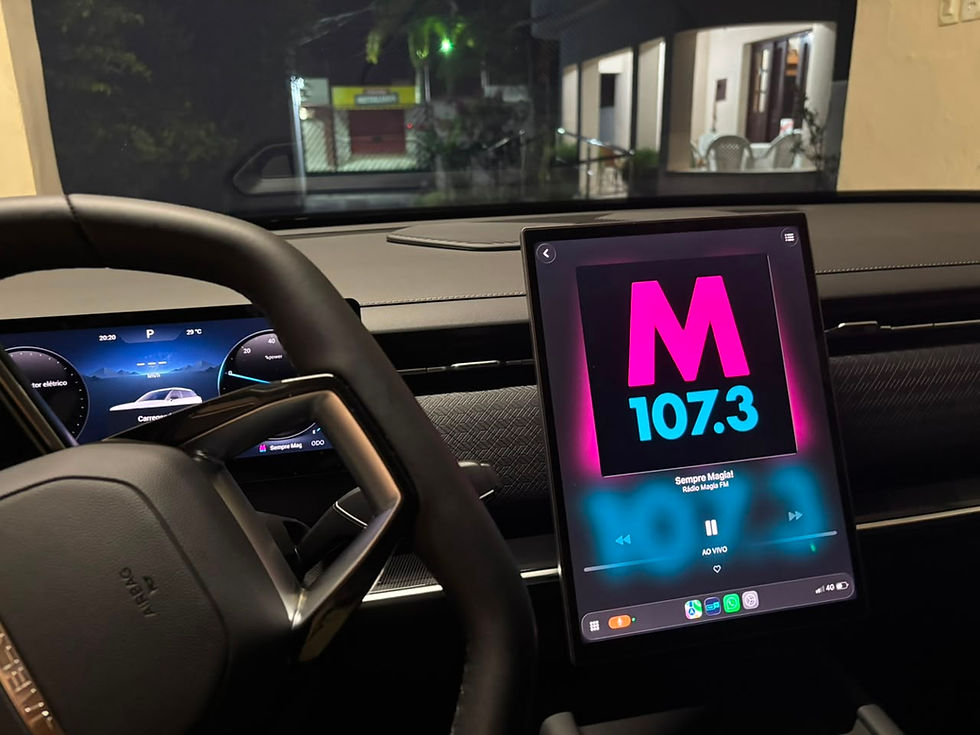
Omoda Jaecoo has already introduced native IP Radio in its 2027 models. And if you ask me whether there is a difference in the quality of Digital Radio delivered via IP Radio compared with HD Radio, DRM, or DAB, my answer is yes....For the better!
IP Radio offers a level of connection robustness that allows broadcasters to explore the highest levels of audio quality, using higher bitrates and, consequently, transmitting much more audio information, with a lower risk of signal loss and interruptions compared with other systems.
The system can also feature an enhanced reception antenna, meaning that 3G, 4G, and 5G signals can be captured more efficiently than by a conventional smartphone in the same location. So, if you leave Natal heading toward João Pessoa and encounter mobile network coverage along 95% of the route, that percentage of connectivity could be virtually continuous inside the vehicle. This would make it possible, for example, to listen to Magia FM, from Florianópolis, in extremely high quality, without static and, most likely, without interruptions during the approximately 180-kilometer journey.
Jaecoo has already begun selling the 2027 Jaecoo 7 Luxury and Prestige models with native IP Radio, equipped with their own dedicated chip and not dependent on third-party routing. This means the vehicles have their own connection and their own catalog of digital radio stations, allowing access to broadcasters with audio streams delivered at a quality superior to FM.
The system also makes it possible to listen to a digital radio station without a distance limit between the studio and the listener, while maintaining the quality of a digital signal, without static and with the full audio spectrum. It also eliminates the dropouts and limitations inherent to modulated transmission, which has physical constraints on how much audio information it can carry and, even so, cannot come close to the audio quality provided by digital IP Radio.
It is a system that is not limited to a few dozen radio stations available in a given region. Nor does it limit reception of a station based on its distance from the studio, as is the case with traditional broadcasting systems. IP Radio does not even limit the language of the radio station you want to listen to or the type of content you wish to access. And for listeners, there is no need to purchase a new dedicated receiver or go through any new licensing process to gain access to this new form of digital radio.
How can I make my station’s digital signal available in the IP Radio standard?
1. Derive the digital output from the audio processor
There is no point in having attractive packaging if the content does not match the quality. Basically, radio stations need to derive a digital output directly from the audio processor.
This digital output has no use for the FM transmitter and, therefore, will probably be sitting idle. It can be used to feed the station’s streaming service with audio quality that is much higher than that of the analog output intended for the transmitter.
The audio sent to FM must go through several specific processes, such as frequency cuts, filtering, compression, and other adjustments that can modify the original signal. These changes are necessary to adapt the audio to the characteristics and limitations of frequency-modulated transmission.
The digital output from the processor, on the other hand, makes it possible to take advantage of a more intact and higher-quality signal for IP Radio.
2. Stream in AAC+ at 64 kbps or higher (L and R)
Stream the audio coming from the processor’s digital output using the AAC+ codec, with a bitrate of at least 64 kbps.
The higher the quality of the audio provided at the source and the more appropriately the encoder is configured, the better the final result will be for the listener.
3. Register the station on MyTuner, TuneIn, and RadiosNet (Radios.com.br)
Register your station with the leading radio streaming portals and directories, especially MyTuner.
Being present in these directories makes it easier for the station to be discovered and integrated into different platforms, apps, and connected entertainment systems.
Your station will not be available as Digital Radio only in Omoda Jaecoo models. Other automakers are already joining the race, and your signal could be available to any user connected to the IP Radio system.
Unstoppable
IP Radio is unstoppable. There is no force equivalent to HD Radio, DRM, or DAB+ capable of simply making IP Radio retreat, because it does not depend on a centralized decision to exist. It is already present in smartphones, apps, streaming platforms, and, increasingly, in vehicles themselves. A radio station can join individually, an automaker can integrate the system, and listeners can start using it immediately.
Trying to stop this evolution would be like fighting against the waves of the sea. IP Radio does not need to replace FM by decree, nor does it have to wait for all broadcasters to simultaneously adopt a new standard. It can advance organically, station by station, platform by platform, car by car, and user by user.
It is precisely this decentralized nature that I consider its greatest strength: while traditional digital radio systems depend on coordinated deployment and specific infrastructure investments, IP Radio grows by leveraging infrastructure that already exists and a consumption habit that has already been established by users themselves.
A System with Permission and Immediate Operation
The standard does not even require new licenses. No broadcaster needs to obtain specific authorization to join the system, as it uses existing IP traffic infrastructure and relies on the common right to send and receive data, just like any person or company in the country with Internet access.
In other words, its operation is tied to Internet access, and as long as such access is permitted in the country, there would be no technical basis for preventing its use. Furthermore, because it operates over IP networks, any attempt to specifically block the system would face the guarantees and principles associated with network neutrality.

Comentários