
IP Radio in the Jaecoo 7
- Ricardo Gurgel

- há 14 horas
- 2 min de leitura
IP Radio in the Jaecoo 7
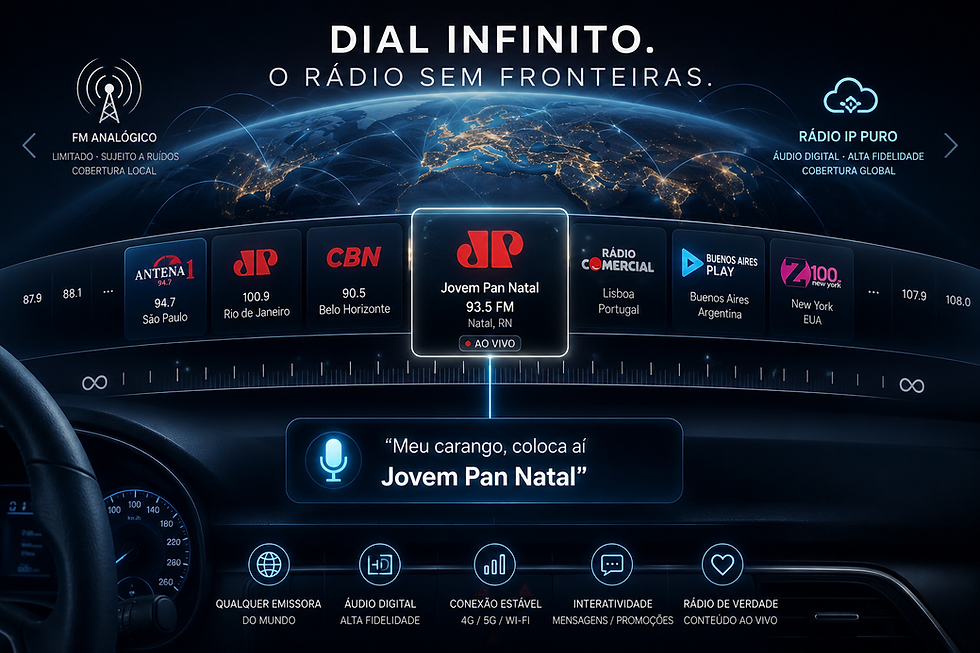
IP Radio directly on the Jaecoo 7's screen: IP-based radio with high-definition audio, excellent clarity and fidelity across the audio spectrum, without hiss, crackles, or signal fading.

It is possible to leave Natal, in the state of Rio Grande do Norte, and travel dozens of kilometers while listening to IP Radio without signal drops. It is also possible to leave the same city and travel more than one hundred kilometers, with total signal losses amounting to no more than five minutes, while maintaining hours of continuous audio. This represents signal availability for more than 98% of the total journey.
And all of this can be achieved using only the basic antenna integrated into the smartphone itself, without considering the gains provided by a vehicle with a native connectivity system and an antenna better designed for this purpose, capable of improving signal reception and significantly reducing coverage shadows and connection interruptions
Regardless of the car used to receive IP Radio, it is important to consider the level of ease of connection, access, and interaction with the system. For this purpose, we can divide the user experience into different levels:
IP-R1 Mode: We can consider a scenario in which the internet connection is provided by the user's own smartphone through mobile hotspot or tethering. Depending on the route, it is possible to travel tens or even hundreds of kilometers without significant connection drops. In practice, this can provide an audio experience equivalent to that of a digital radio system configured with a high bitrate. It is also common to travel more than one hundred kilometers with less than 0.5% of the total time without audio. In this mode, the user selects the station directly through the vehicle's interface.
IP-R2 Mode: The internet connection is native to the vehicle, through a SIM card or eSIM integrated into the vehicle's system, eliminating the need to use the user's smartphone as a hotspot. The user selects the station directly through the vehicle's interface.
IP-R3 Mode: In addition to the vehicle's native internet connection, provided through an integrated SIM card or eSIM, the system uses a suitable antenna optimized for the vehicle, providing better reception conditions and greater connection stability. The user selects the station directly through the vehicle's interface.
IP-R4 Mode: This represents an evolution in the user experience. The internet connection is native to the vehicle, through an integrated SIM card or eSIM, and optimized by a suitable antenna integrated into the vehicle. In this mode, the user can simply use voice commands to request the station they want to listen to, and the vehicle's system automatically searches for the station and starts playback.

Comentários