
Advertisers paying to send PDFs via digital radio? Discounted movie tickets arriving on my receiver? A new kind of RDS? Perhaps DRM will allow it!

Atualizado: 1 de ago. de 2025
PDFs delivered to your radio, have you ever imagined that?
It could be a study guide, a scientific article, an informational flyer from the neighborhood grocery store, or even an image file in JPEG or GIF format, just imagine receiving them directly on your digital radio receiver! Picture me here, in a small town near Natal, getting a commemorative PDF with the history of the BBC in London, 2 or 3 pages long, just because I happened to tune in at the right time.
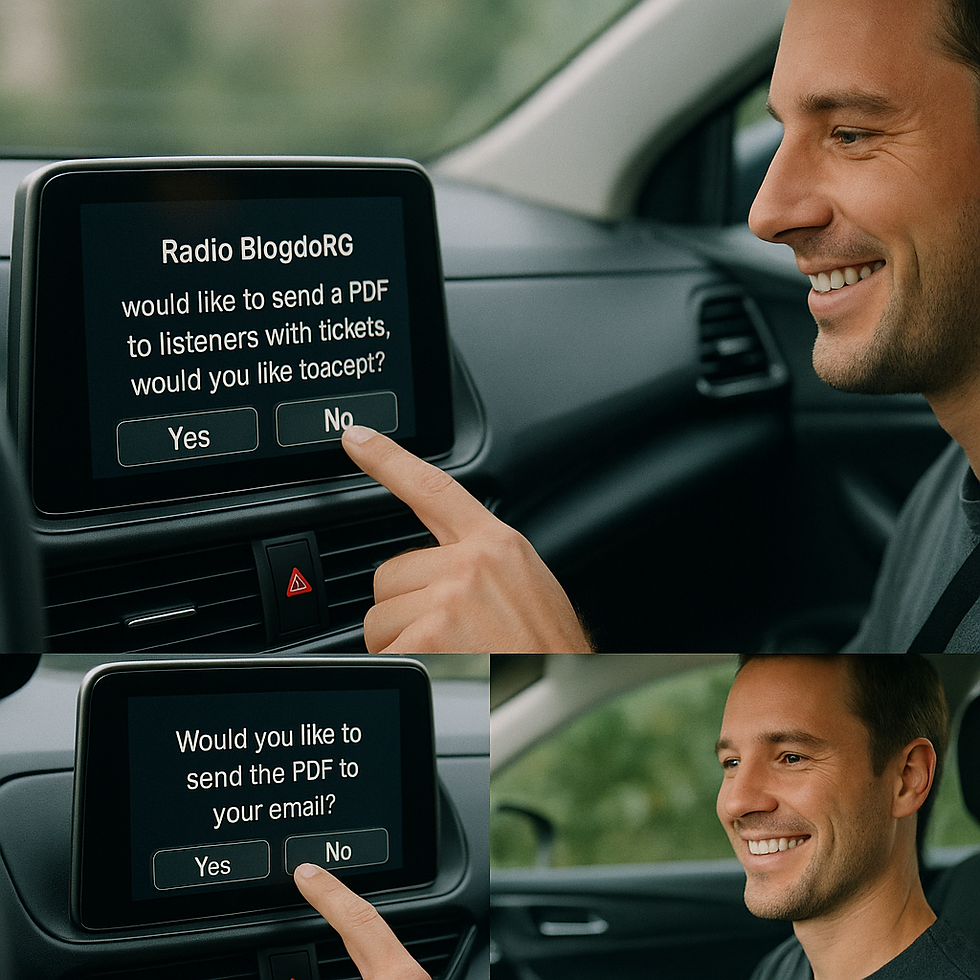
A message would appear on the screen indicating the content is available, either from the station itself or from a sponsor. I would accept the download, and the receiver would either store the file or automatically send it to my pre-configured email, phone, or computer. That way, the device’s memory stays free for future gifts from the station.
Now imagine, in the year 2030, a digital radio host announcing to the audience:“Everyone tuned in this Wednesday between 10 a.m. and 11 a.m. will receive a PDF of our guest’s book!”Or: “You’ll receive a JPEG image with a QR code that gives you a discount on movie tickets!”All of this sent straight to your radio!
Downloading files broadcast alongside the audio
The radio’s screen would notify you that a file is available, and you'd have the option to download it directly to the receiver. Once accepted, it could be stored or forwarded via email, Bluetooth, or any connected device.

Of course, we wouldn’t want listeners to be flooded with unwanted files. That’s why the receivers themselves would check if a file has already been received, avoiding repeats. Also, supported formats would initially be limited to avoid malicious code. Major companies like Adobe could sponsor their integration into the system, enabling safe and desirable PDF content, from lessons and books to advertising, to be distributed easily and securely.
Increasing value to radio
Digital radio receivers could become even more valuable if offered with varying memory capacities to safely store such content. This would become a powerful loyalty tool: the station offers the content, and the listener chooses whether to download it or not. Meanwhile, the broadcaster could sell sponsorship slots to advertisers during low-traffic hours, like late night or early morning, for digital giveaways. Picture a listener receiving a PDF containing a discount coupon for a movie premiere, with ad space for the sponsor. The station wins, the sponsor is seen, and the listener is rewarded, everybody benefits.
And we’re not talking science fiction. Technologically, this is entirely feasible. RDS is already a primitive version of this, transmitting text through the FM carrier. The difference is that digital radio could send complete, sophisticated files, images, texts, even e-books. Radios may or may not include this feature, but it’s easy to imagine the market leaning toward models with more memory and built-in screens, driving innovation through this new form of media appeal.
I visualized the situation on the road
I remember one Monday night, driving on the BR-101 highway out of Parnamirim, thinking about all the tasks waiting for me at home. I had several files to send to different people. Then I thought: “What if I were a radio station and all those people were tuned in?” I could have solved everything in a few minutes. But then I had a better idea: “Even more effective than just talking would be if I could send, via digital radio, them PDFs and images along with my voice.” That way, they could access the content whenever they had time and focus to read it properly.
An experiment
If I had a receiver today that could store all the RDS screen messages sent by an FM station in chronological order, after a few hours of listening I’d have pages of content. With a simple system, this could be turned into TXT, DOCX, or PDF files, allowing the broadcaster to send recipes, Bible verses, shopping lists, or whatever they wanted. It’s an entirely viable experiment. An FM transmitter with an RDS generator could send one sentence of a recipe every 15 seconds, and a computer with a radio capture card could decode the stream and reconstruct the full message.
But with digital radio, the possibilities go far beyond that.


