
People are confusing defending “Radio” with defending “FM”
- Ricardo Gurgel

- 16 de abr.
- 8 min de leitura
The migration from AM to FM
AM and FM are just transport layers for radio. In the beginning, radio was “packaged” in AM, and for many years that was the main format by which it was known. When FM arrived, there was resistance: AM fans argued that FM could not cover the same distances, while FM advocates replied that AM could not deliver the sound quality FM offered.
For a time, that was the tradeoff: AM provided reach, FM provided audio fidelity or at least something close to it.
As electrification increased in cities, both outdoors and inside homes, AM began to face serious electromagnetic interference. A simple fluorescent lamp, for example, can completely wipe out AM reception in a bedroom or living room. At that point, it was no longer a matter of taste between AM and FM; with the light on, there was often no usable AM signal at all, unless the house was very close to a transmitter.
Even so, people kept tuning to AM because key content, like soccer, was still there. Over time, though, FM also began to carry soccer. And not just that: talk shows, debates, news, and religious programming realized they could use the same content that had been on AM and simply deliver it on FM. In other words, they understood they were only changing the transport layer.
It is true that something was lost: the huge coverage area of AM. You could no longer pick up a station 300 km away at night, or hear Rádio Globo from Rio on 1,220 AM, for example, on a beach near Natal during a Flamengo match.
But stations realized they needed to focus on their real audience within their actual markets 50,000, 100,000, 500,000, even 1 million inhabitants within their area of influence, rather than on occasional listeners scattered thousands of kilometers away.
What was the real tradeoff?
It was choosing between poor sound quality in their own city with the possibility of reaching 2,000 kilometers away, or delivering good local quality with less range. For advertisers, a huge coverage area mattered very little if the station could only be heard under very specific conditions, far from electrical interference and, often, only with incandescent light bulbs.
Criticism increased when Brazil regulated the migration of AM stations to FM. The most passionate listeners were left to complain and complain loudly. But those same listeners were unlikely to join campaigns to fund the high costs of operating an AM station.
In the end, the stations moved to FM and got into people’s homes more consistently. FM signals are not completely immune to electrical interference, but they suffer far less from it than AM. So broadcasters chose to prioritize a more stable audience in their own cities instead of maintaining a vast coverage area with very few effective listeners.
AM had reach; FM had sound quality. AM suffered from interference from fluorescent or LED lamps; FM was limited by geographic obstacles. However, AM’s main advantage reach was concentrated at night, just as television was becoming the dominant medium in Brazilian daily life and in many other parts of the world.
In other words, AM achieved its greatest range outside normal commercial hours. Unsurprisingly, that slot gradually became a kind of infomercial showcase, with heavy emphasis on direct sales programming. Over time, as a result of this model, around 90% of the band came to be occupied by religious broadcasters, which rely on external funding and are less dependent on traditional advertising.
Being radio is not being AM or FM. Being radio is reaching listeners.
AM held off FM for many years because it offered reach. FM then grew year after year because it offered better sound. Would FM itself withstand competition from a medium that offered both higher audio quality and much greater reach?
Questions
How would that even work?
Take HD Radio: it does not offer greater coverage than an analog FM signal. It can improve sound quality, but it does not extend the footprint.
With DRM, to cover large distances you have to cut the bit rate dramatically. If you don’t, packet loss increases and reception falls apart. Under those conditions, how do you sustain high quality?
DAB, in turn, depends on a dense network of transmitters and gap-fillers to guarantee continuous coverage. How do you make that model economically viable?
If I had to drive from Natal to Recife (about 300 km) listening to the same station for 98% of the trip, in high quality, and still record the entire route, I would win a R$ 10,000 bet easily.
Do you need to be a genius to guess how? Here’s the hint: the word starts with “streaming.”
When “Alexa” becomes standard in cars, it will choose the high quality of your streaming, not your noisy FM signal. Is your radio station prepared?
In Brazil, approximately 92% of the population uses the internet, while around 95% lives in areas with mobile network coverage. Of this, roughly 65% already has access to 5G coverage.
In addition, more than 99% of people who own a car have access to mobile internet, either directly in the vehicle or through a smartphone.
"In practice, this means that DIGITAL RADIO in cars is already available to virtually the entire motorized population IN BRAZIL."
But this is not digital radio!
Are you sure it isn’t? The 4G and 5G signal is an electromagnetic radio signal, and everything carried within that transmission is digital. What we have is a radio transmission of digitized content, and most importantly, the audio is often superior to many DAB or DRM radio stations that still choose low bitrates.
When “Alexa-Car” becomes standard in cars, it will choose the high quality of your streaming, not your static filled FM signal when playing audio for the driver and passengers. It would only consider switching to your FM signal if you were truly in an area without mobile internet. But if there is no internet in that place, is there even FM coverage? In the past, the answer would be yes. But today, taking Brazil as an example, a developing country, over 95% of the population is already covered by mobile internet at affordable prices. Is your radio station prepared?
Listen to this clip!
Yes, this can be the sound of your radio station, without noise, with a wider frequency range, with brighter highs and deeper lows than what is possible on FM.
You get into the car and ask “Alexa-Car”, in the near future, to play Jovem Pan. Then, this is the sound you will hear:
You listen to Jovem Pan and think that, basically, the only change was the voice command, no longer needing to use your hands to tune. But in reality, that is not all that changed.
Notice this: there is no noise. The bands seem to play with more instruments. The guitars sound brighter in the highs, and the bass has more weight and definition.
So the question arises: what is the point of listening, in neighborhoods surrounded by buildings and already a few kilometers away from the transmitters, to a signal with noise and dropouts, or at least muffled due to the loss of information in the radio wave, if the same station can be heard with much higher quality, without noise, and with far greater clarity?
And no, I am not talking about listening to Jovem Pan in HD Radio, DRM, or DAB. That does not even exist as a real perspective in Brazil.
In practice, even without any Alexa at all, you can already listen to Jovem Pan with exactly this level of quality today.
If you have a smartphone and your car radio has bluetooth, then you already have access to several digital radio stations with high definition that surpasses the quality of DAB or DRM. This is simply because they operate above 60 kbps in AAC+, with no need for lower configurations.
In this scenario, you are the one choosing to listen to Jovem Pan via streaming instead of FM. You are still listening to the radio, but not through an analog transmission, rather a digital one. However, in the future, people will listen to the digital version thinking they are listening to traditional FM, when in fact they will be using streaming.
You might ask: how will this happen?
The answer is simple. Cars are increasingly equipped with media centers that function like true Alexa systems. The user will simply say which radio station they want to hear. Knowing that streaming audio is superior and free of noise, this Alexa will not ask whether you want to listen via the FM antenna or via streaming. It will simply choose streaming.
The system will not opt for an analog signal subject to interference. Today, any major city already has solid 4G and 5G coverage. In practice, you will be listening via streaming, and the listener will fall in love with that sound quality.
High audio quality: many streams use 64 kbps AAC+, and several offer stable transmissions at 128 kbps AAC+ and MP3, without compromising coverage, whereas increasing bitrate in systems such as DAB or DRM can reduce coverage.
Sound perfection, provided that:
The stream runs at least at 64 kbps in AAC+, with audio coming from the digital output of the audio processor. There is no point in streaming at 256 kbps MP3 if the audio sent from the station to the server is poor. Quality must be ensured at the source.
Prepare for this reality. Is your radio station ready to deliver excellence in streaming?
This situation has effectively eliminated the urgency for radio digitalization in Brazil.
Broadcasters have no real interest in taking on the costs of adopting a digital radio system. There is little willingness to invest millions in transmission infrastructure while facing strong uncertainty about whether listeners would buy expensive and more complex receivers just to access DAB, DRM, or HD Radio audio.
Listeners already have access to high quality audio without needing to purchase digital radio receivers. Stations are already delivering high fidelity sound, often superior to many digital radio systems around the world, through streaming. I experience this every time I leave home. The technology itself has become a strong barrier to entry for any traditional digital radio system, because it is already here. I have a smartphone, a data plan, and a native media center in my car

Does it make sense to think this: “many people still do not know how to listen to your station’s streaming in the car”?
If someone struggles to access streaming in the car, you can be sure that the barrier for that same person to consider buying an HD Radio receiver is much higher. And waiting for the vehicle fleet to gradually come equipped with native receivers is a slow process that already lags behind any solution based on voice assistants.
And this does not take much effort to understand: an Alexa like solution built into the car is far more appealing than a device dedicated only to digital radio.
Because, in practice, an intelligent in car media system offers:
Local digital radioNational digital radioInternational digital radioAn infinite dialMedia beyond radio, such as YouTube, Spotify, and others
There is no real competition here
The disruptive model will not arrive to hinder the adoption of digital radio in Brazil, it is already present. And more than that, it reduces the very incentive to implement traditional digital radio models.
Which of these is impossible to listen to exactly in your car?


Can’t you listen to the stations above? Are you sure? Even this basic car model makes it possible to listen to any of those stations, anywhere in Brazil, and these built-in infotainment systems will increasingly make it easier to access digital radio (via streaming), with high audio quality.
Can’t you listen to the stations above? Are you sure? Even this basic car model makes it possible to listen to any of those stations, anywhere in Brazil, and these built-in infotainment systems will increasingly make it easier to access digital radio (via streaming), with high audio quality.
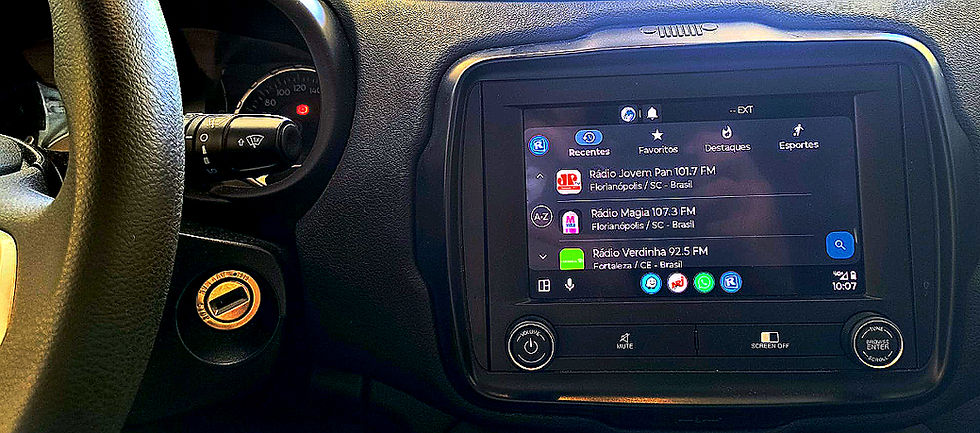
But it’s very complicated to put streaming in the car, it won’t become popular…
Well, as I just said, things are becoming increasingly intuitive, and giving a voice command like “Car, I want to listen to Z100” is, let’s be honest, trivial. This already exists, and the car will simply pull the high quality stream of Z100 without worrying about fluctuations in its HD Radio signal.


Comentários